FlashDexRetarget

Accelerating Dexterous Manipulation Data Generation through Multi-Motion Retargeting

1KAIST AI 2Holiday Robotics *Equal contribution
Paper Video Code (coming soon)
One policy, many motions. Successful rollouts of a single FlashDexRetarget policy on our 50-motion benchmark (XHand, single- and two-object demonstrations from TACO, OakInk2, and HOT3D).

FlashDexRetarget turns a whole collection of human hand–object demonstrations into physically grounded robot trajectories with one reference-conditioned RL policy, instead of optimizing every demonstration separately.

90%
retargeting success on the 50-motion benchmark (XHand, with object-size reward normalization) in 32 GPU-hours
~100×
less training compute than CHORD (XHand: 32 vs. 2,847 GPU-hours), with 44 pp higher success
600+
of 1,000 motions converted by one policy trained on the whole collection, within 600M steps

Video

Retarget a Whole Collection with One Policy

Physics-based retargeting makes a human demonstration executable by a robot hand: the robot must reproduce the demonstrated object motion through its own contacts, under its own dynamics.

Human demonstration
Reference motion
Retargeted robot trajectory

Existing sampling-based and RL-based retargeting methods optimize each demonstration independently, so their cost grows linearly with the number of demonstrations. FlashDexRetarget instead studies multi-reference tracking: a single reference-conditioned policy is trained jointly across all reference motions, amortizing training over the whole dataset, and every successful rollout is stored as robot data.
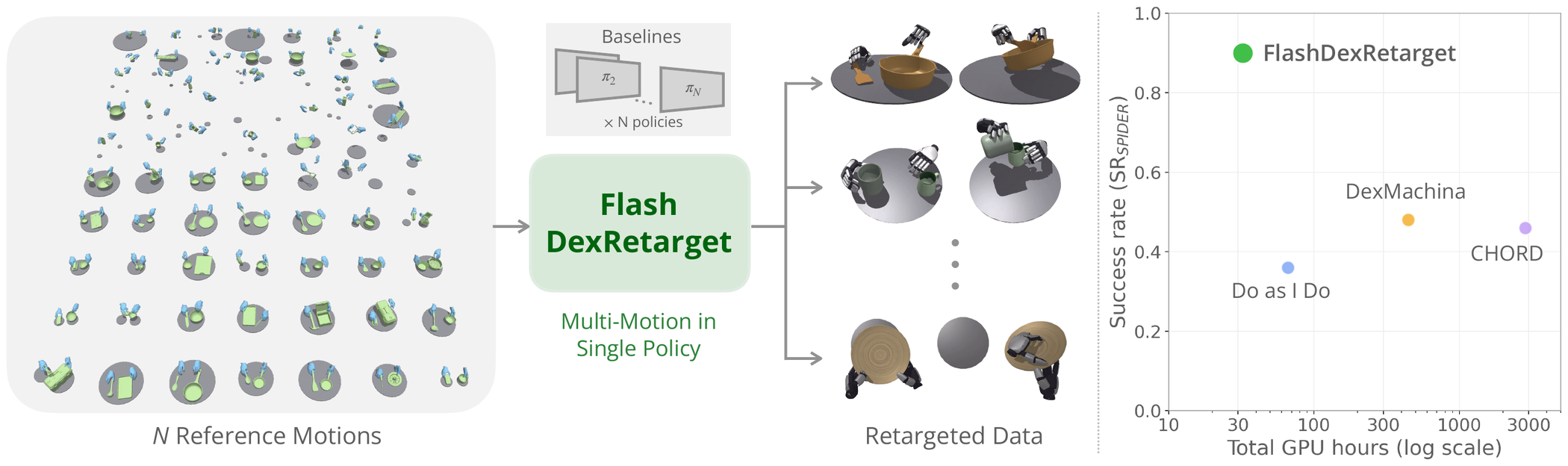
FlashDexRetarget at a glance: N reference motions, one policy, retargeted data, and success rate versus GPU hours
FlashDexRetarget at a glance. Left and right hand policies are jointly trained across reference motions, avoiding repeated optimization for individual demonstrations, and successful rollouts are stored as robot data. The right plot shows cumulative conversion success rate versus total GPU hours on a logarithmic scale.

Method

Reference trajectories are sampled from the dataset and assigned to parallel simulation environments. At every step the policy sees the current simulated state together with the next reference state and predicts the robot action.

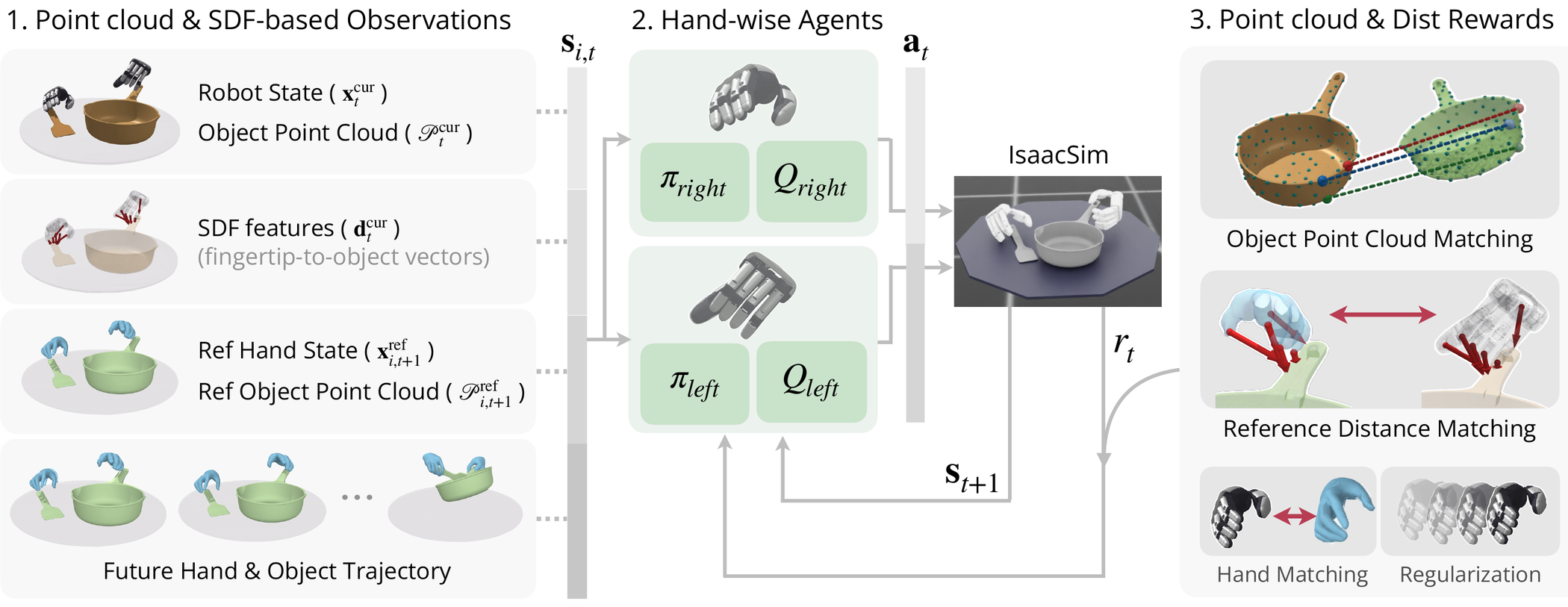
Overview of FlashDexRetarget: observations, hand-wise agents, and rewards
Overview. (1) Observations combine robot states, current and reference object point clouds, local signed-distance features, and an encoding of future reference motion. (2) Left and right hand actor–critic pairs are trained with FlashSAC and jointly control the simulated interaction, each sharing its parameters across all reference motions. (3) Object surface alignment and reference-conditioned fingertip proximity provide geometric learning signals, complemented by hand tracking and regularization.

Interaction-aware observations

Observation

Object point clouds

One policy has to handle many objects, so it observes their shape instead of memorizing one: 128 uniformly sampled surface points for the current simulated pose and for the next reference pose, expressed in the wrist-local frame.

Current cloudsimulated object
Reference cloudfrom the demonstration
Observation

Hand–object distance features

To describe the local hand–object relationship, including before contact, we query a signed distance field for the distance and surface normal from each fingertip and the wrist to the object, in the wrist frame.

Fingertip-to-surface vectorsduring a rollout
Observation

Future reference conditioning

A single next frame cannot tell where the motion is going. We encode the reference hand and object states from \(t+1\) to \(t+K\) (\(K = 10\)), relative to the current wrist frame, into a 128-d latent with a temporal encoder.

Next 10 reference framesreference hand & object poses

Geometric tracking rewards

Reward

Object point-cloud matching

Instead of weighting translation and rotation errors by hand, we compare corresponding surface points and average the \(k = 3\) largest errors, a single metric that captures both. For a uniform reward signal across object sizes, the object-frame surface points are first rescaled to a common radius \(\rho = 0.058\) m, so that a 30° rotation yields a 3 cm error, matching the success thresholds:

$$e^{\text{obj}}_t = \frac{1}{k}\sum_{m \in \mathcal{I}^{(k)}_t} \big\lVert \tilde{\mathbf{P}}^{\text{cur}}_{t+1,m} - \tilde{\mathbf{P}}^{\text{ref}}_{i,t+1,m} \big\rVert_2, \qquad r^{\text{obj}}_t = \exp\!\big(-e^{\text{obj}}_t / \sigma_{\text{obj}}\big), \qquad \tilde{\mathbf{p}}_m = \rho\,\frac{\mathbf{p}_m}{\max_n \lVert \mathbf{p}_n \rVert_2}$$

with \(\sigma_{\text{obj}} = 0.1\) m.

Worst-3 point pairscurrent vs. reference
During a rolloutpoint-cloud matching
Reward

Reference distance matching

Reconstructed contacts are noisy: fingers float above the object or sink into it, so binary contact labels are unreliable. Instead, each robot fingertip should be at least as close to the object as the human fingertip was:

$$\varepsilon^{(f)}_t = \max\!\big(0,\; d^{(f)}_t - d^{\text{ref},(f)}_t\big), \qquad r^{\text{int}}_t = \frac{1}{5}\sum_{f=1}^{5} \exp\!\big(-\varepsilon^{(f)}_t / \sigma_{\text{int}}\big)$$

with \(\sigma_{\text{int}} = 0.01\) m. A hand-tracking term and regularization complete the per-hand reward.

Reference distanceshuman fingertips
Robot distancesrobot fingertips (SDF)

Learning

Architecture

Per-hand actor–critic

With one shared critic, the rewards of both hands collapse into a single scalar. Each hand therefore gets its own actor and critic, trained with its hand-specific reward. Both actors observe the full bimanual state but control only their own hand, staying physically coupled through the simulation.

RL algorithm

Scaled off-policy learning

Many references share one policy, so experience is too valuable to discard. We adopt the off-policy algorithm FlashSAC and scale it to the broader multi-reference state distribution.

Replay buffer 10M → 50M Critic width 256 → 1024

Results

Higher success at a fraction of the compute

We compare against Do as I Do, DexMachina, and CHORD on 50 reference motions (25 single-object from HOT3D and 25 two-object from TACO and OakInk2), retargeted to XHand and Sharpa Wave Hand. All methods are evaluated in IsaacSim on NVIDIA RTX 3090 GPUs. Each single-reference run stops once a successful rollout is found, and GPU-hours are summed over all motions, including the full cost of unsuccessful runs; FlashDexRetarget trains one policy for 300M environment steps.

MethodMotionSRSPIDER ↑SRMT-Obj ↑ SRMT ↑MOPE (mm) ↓MORE (rad) ↓GPU-h ↓
(a) XHand
Do as I DoSingle0.360.040.0047.320.2866
DexMachinaSingle0.480.320.1237.490.29447
CHORDSingle0.460.020.0055.700.162,847
FlashDexRetarget†Multi0.900.860.8610.950.2532
(b) Sharpa Wave Hand
Do as I DoSingle0.640.100.1058.330.2462
CHORDSingle0.500.220.0060.070.193,314
FlashDexRetargetMulti0.720.600.6017.280.2936

SRSPIDER: object position / rotation error within 10 cm / 0.5 rad, averaged over the objects of the active hands. SRMT-Obj: object within 3 cm / 30°. SRMT: additionally fingertip and hand-joint position errors within 6 cm and 8 cm. MOPE / MORE: mean object position / rotation error over trajectories that satisfy SRSPIDER.
†Uses object-size normalization in the point-cloud matching reward. It is applied only to the XHand result; the Sharpa Wave Hand, ablation, and scaling results do not yet use it.

What makes multi-reference retargeting work

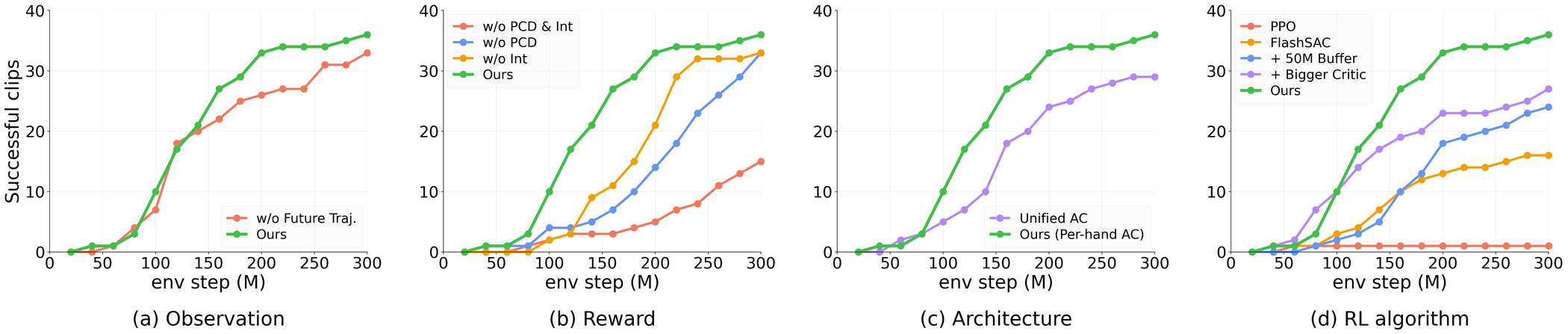
Ablation curves: observation, reward, architecture, RL algorithm
Cumulative number of successfully converted reference motions (out of 50) over 300M environment steps; a reference counts once a rollout satisfies SRMT-Obj.

Scaling to larger reference collections

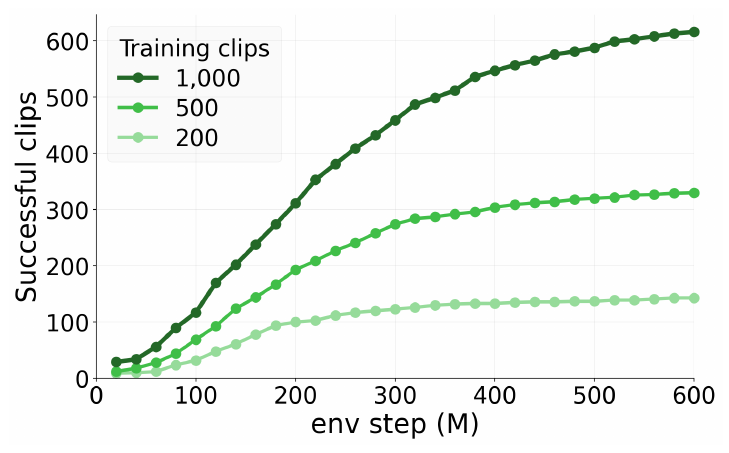
Cumulative successful clips for 200, 500 and 1,000 training motions

When one shared policy is trained on collections of 200, 500, and 1,000 motions (600M environment steps each), larger collections yield more successfully retargeted motions within the same environment-interaction budget.

Sharing training across more references therefore increases the data-generation yield of a single training run: more demonstrations in, more robot data out.

Real-World Replay

We retarget real-world-captured human demonstrations and replay the successful simulated trajectories on a robot arm with an XHand. This checks that the retargeted motions remain executable under real contact dynamics; it is not a closed-loop deployed policy.

Captured human reference
Retargeted in simulation
Real robot (4× speed)
Wipe the board
Pour into the pan
Close the lid

BibTeX

@misc{lee2026flashdexretarget,
  title  = {FlashDexRetarget: Accelerating Dexterous Manipulation Data Generation through Multi-Motion Retargeting},
  author = {Lee, Kyungmin and Kim, Sibeen and Hwang, Dongyoon and Oh, Yoonsang and Kim, Donghu and
            Lee, Youngdo and Nahrendra, I Made Aswin and Choo, Jaegul and Lee, Hojoon},
  year   = {2026}
}